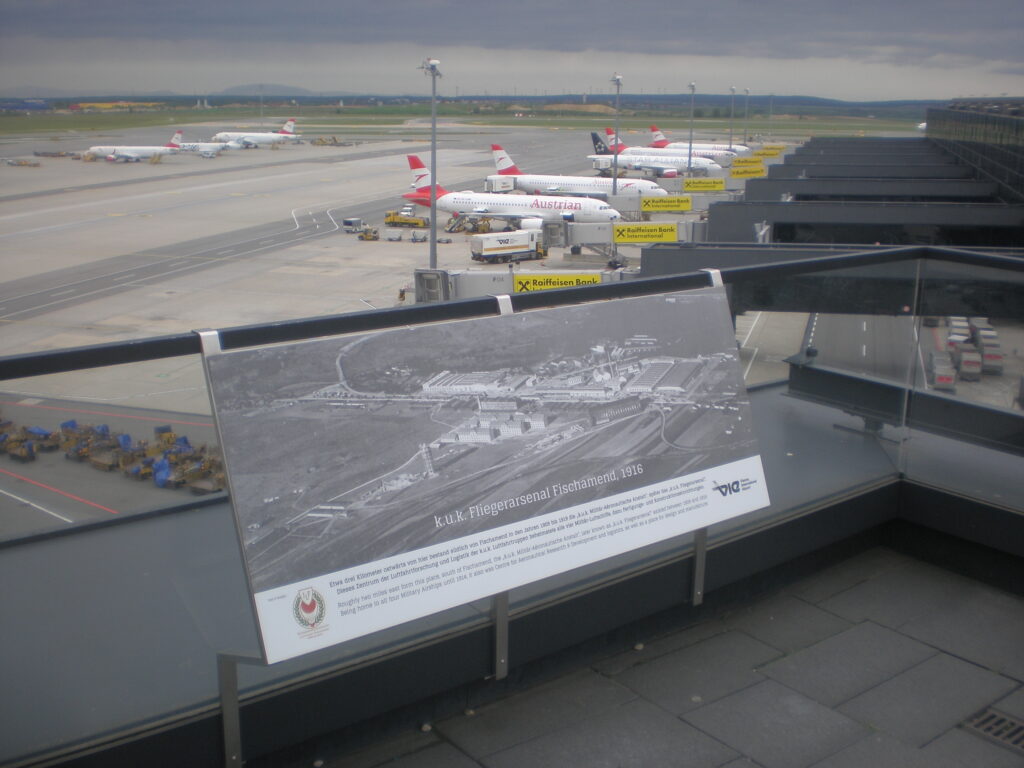
Photo: Fischastadt · License: CC BY-SA 4.0 · Source: Wikimedia Commons
Even before the Aspern airfield existed, the k.u.k. Military Aeronautical Institute at Fischamend, just a few kilometres from today’s Vienna Airport, had become the largest aviation research facility in the entire Habsburg monarchy. Pioneers as different as Ferdinand Porsche and Theodore von Kármán later worked there, and in 1914 the site was also the scene of the worst air disaster in the monarchy’s history. Today the place is largely forgotten, with only a water tower, a listed workshop hall and former barracks buildings still recalling its significance.
Founded in 1909 and the rise of the air troops
As the previous site at the Vienna Arsenal became too small for the monarchy’s balloonists, the army purchased land at Fischamend and built the Military Aeronautical Institute there in 1909, with an airfield, an airship hangar, a gas plant and a guardhouse. Its first commander was Franz Hinterstoisser, after whom the Zeltweg air base is still named today. The institute tested and built, under licence, Parseval and Lebaudy type airships, developed and flew aircraft such as the Etrich Taube, and repaired damaged machines. Historian Rudolf Ster called it “the largest aviation research facility in the entire Danube Monarchy.”
Pioneers of aviation technology
At Fischamend, Theodor Scheimpflug developed his photogrammetric method for aerial surveying, radio experiments were already underway before the First World War, and a wind tunnel and a propeller test rig were added later. During the First World War, the young Ferdinand Porsche also worked at the institute. Together with Stephan von Petróczy and Theodore von Kármán, who later became a pioneer of aerospace science, researchers worked from 1917 on the institute’s last major project: tethered observation helicopters, the PKZ-1 and PKZ-2, intended to replace the observation balloons then in use and regarded today as forerunners of the later coaxial helicopter principle.
The Körting tragedy of 20 June 1914
On 20 June 1914, the worst air disaster of the Habsburg monarchy occurred over Fischamend. The airship “Körting”, the last military airship of the k.u.k. Army, had taken off with a crew of seven under the experienced airship commander Captain Hans Hauswirth for a photogrammetric survey flight using Scheimpflug’s camera apparatus. A biplane flown by pilot Ernst Flatz, with Frigate Lieutenant Wolfgang Puchta aboard as a passenger, circled the airship repeatedly, for reasons still unclear today, and eventually collided with it. Both men aboard the biplane died instantly in the crash, and shortly afterward a jet of flame burst from the airship’s envelope, which fell burning and killed all seven crew members.
Archduke Karl Franz Joseph, the then heir to the throne and later Emperor Charles I, visited the crash site on the day of the accident. The victims were buried with military honours at Vienna’s Central Cemetery on 24 June 1914, accompanied by a flyover from Aspern. The disaster effectively ended the airship era in the k.u.k. Army, only days before the assassination in Sarajevo set Europe on the path to the First World War.
The First World War, the end, and what remains
With the outbreak of war the institute quickly grew to around 300 officers and 5,000 men and civilian staff. After the war, its facilities had to be dismantled or removed under the terms of the Treaty of Saint Germain. During the Second World War, the Luftwaffe used the site as a reserve and auxiliary field and as a satellite location of the Wiener Neustadt aircraft works, whose main plant was destroyed by Allied bombing in 1944. After the war ended, the Red Army looted what remained of the site. Housing was later built over much of the grounds. Of what was once the monarchy’s largest aviation research site, only a water tower, a listed workshop hall, the former officers’ mess, now used as a community hall, and a few street names remain today. In 2009, to mark its hundredth anniversary, the field received a temporary 500 metre grass runway and the ICAO code LOWF for two days, and on 6 June 2009 an Antonov An-2 landed there, the first aircraft to do so in more than sixty years.
Further reading: Vienna-Aspern Airfield · Austrian Aviation History
Sources (Selection)
- forgottenairfields.com: Airfield Fischamend
- militaeraktuell.at: The Fischamend Military Aeronautical Institute
- militaeraktuell.at: The Last Voyage of the Körting Tragedy over Fischamend
Part of the Austrian Aviation History section. An independent, private history project with no affiliation to Austrian Airlines AG or the Lufthansa Group.