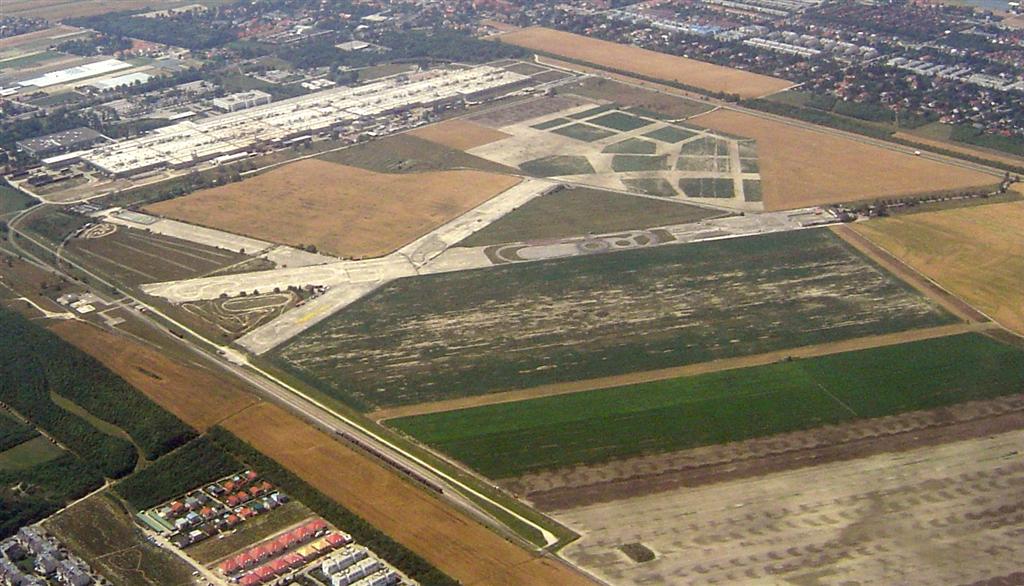
Photo: Christian Wirth (Wirthi) · License: CC BY-SA 3.0 · Source: Wikimedia Commons
Before Vienna-Schwechat took over civil air traffic in 1954, the Aspern airfield in what is now Vienna’s 22nd district had for decades been the city’s gateway to the sky: host to the first international air meetings in the Habsburg monarchy, home to Austria’s first airline, and for a time, by its own claim, the “most international airport in the world.” Today it is mainly street names such as Flugfeldstraße and Pilotengasse that recall the site’s eventful history, where the Seestadt Aspern district now stands.
Founding and the age of air meetings (1912 to 1914)
As the previously used Simmeringer Haide field became increasingly built up, the Wiener Flugfeld-Gesellschaft m.b.H. founded a new airfield at Aspern in January 1912. Its opening on 23 June 1912, with an international air meeting, drew around 100,000 visitors, about 50,000 of them on the grounds themselves, along with roughly 6,000 automobiles at a time when cars were still a rarity. Three accidents occurred on the opening day alone, while four world records were set at the same meeting. Aspern was from then on considered “the most modern airfield in the world.”
On 9 June 1913, Count Zeppelin and Hugo Eckener landed the airship “Sachsen” at Aspern, and a week later Emperor Franz Joseph I personally attended the second international air meeting. In 1914, pilot Heinrich Bier set four altitude world records in a Lloyd LS-1, eventually reaching 5,440 metres. At the third international air meeting in June 1914, news arrived of the assassination of heir to the throne Franz Ferdinand in Sarajevo, a turning point that abruptly ended Aspern’s brief heyday as Europe’s “hub of aviation.” With the outbreak of war, civil aviation was suspended and the field was used purely for military purposes, including test flights of new aircraft from the nearby Aviatik works.
The world’s first airmail line and the ÖLAG
On 31 March 1918, the world’s first regular international airmail line began operating out of Aspern, initially to Kraków, Lviv and Kyiv, later extended to Odesa and Budapest. After the war and the restrictions of the Treaty of Saint Germain, Aspern reopened to international traffic in 1922, and on 1 May 1922 the French carrier CIDNA became the first international airline to open a route there, Paris to Prague to Vienna to Budapest. On 21 April 1924, the newly founded Österreichische Luftverkehrs AG (ÖLAG), Austria’s first airline, began operations with Aspern as its home airport.
The airport grew quickly: year round flying began in 1928, and a new terminal building with a ticket hall, control tower and a Mitropa restaurant opened in 1929. By 1930, ten airlines served Aspern, including Lufthansa and Imperial Airways, with Air France, Swissair and KLM following later, and the airport earned the title “most international airport in the world.” On 12 July 1931, the airship LZ 127 “Graf Zeppelin” under Hugo Eckener visited the site before as many as 120,000 spectators, attended by Federal President Miklas and Chancellor Buresch. In 1935, ÖLAG stationed its first Junkers Ju 52/3m aircraft at Aspern.
Civil war, the Anschluss and the Second World War
In February 1934, the well known flying ace Godwin Brumowski took off from Aspern for the only air attack of the Austrian Civil War, against the Goethehof municipal housing block. After the Anschluss in March 1938, units of the German Luftwaffe landed at Aspern and turned the site into a Luftwaffe base. On 29 May 1938, Aspern was the final stop of the “Deutschlandflug”: 347 aircraft landed there on a single day, more than ever before. During the Second World War the airfield was expanded, partly using forced labour, and three concrete runways were built. On 5 April 1945, Lufthansa’s civil flight operations ended, and shortly afterward the last crews left the site.
Soviet occupation, a race track and the end (1945 to 1977)
After the war ended, the Red Army seized the remaining facilities and turned Aspern into a base for a guards bomber division. Only at the end of 1955, after the occupying powers withdrew, did the Austrian Aero Club take over the site as a civil airfield for sport aircraft. From June 1956, the airfield’s taxiways also hosted car races, which always drew large crowds. Because the new second runway under construction at Schwechat was given an approach path that lay too close to Aspern, flight operations there ceased already in spring 1977, before the new runway officially opened on 6 October 1977. According to legend, the last aircraft left the field trailing a black mourning flag. Most of the flying clubs relocated to Wiener Neustadt.
From the Opel plant to Seestadt Aspern
In 1980 and 1981, on the initiative of Chancellor Bruno Kreisky, a General Motors engine plant, later Opel Wien, was built on a separated part of the grounds and began regular operations in 1982. The remaining taxiways served for a time as an ARBÖ driving practice area and for occasional air shows, the last of which was held in 1997. On 3 July 2009, the last remnants of the former runways were demolished, and development of the Seestadt Aspern district began the same year, aiming to house and employ more than 20,000 people by 2028. Of what was once central Europe’s largest airport complex, mainly street names such as Flugfeldstraße, Pilotengasse and Fliegerweg remain as a reminder.
Further reading: Vienna International Airport · Austrian Aviation History
Sources (Selection)
- Wikipedia: Flughafen Aspern (German)
- flugfeld-aspern.at: Chronik (German)
- austrianwings.info: Aspern, Wiens ehemaliger Flughafen (German)
- Geschichtewiki Wien: Flugfeld Aspern (German)
Part of the Austrian Aviation History section. An independent, private history project with no affiliation to Austrian Airlines AG or the Lufthansa Group.